 Tetcolor
Tetcolor Duo — Match colors and clear rows
Tetcolor Duo puts two clearing rules on the same board. Every falling shape carries independently colored blocks, so a placement can finish a color match, complete a row, or set up both at once.
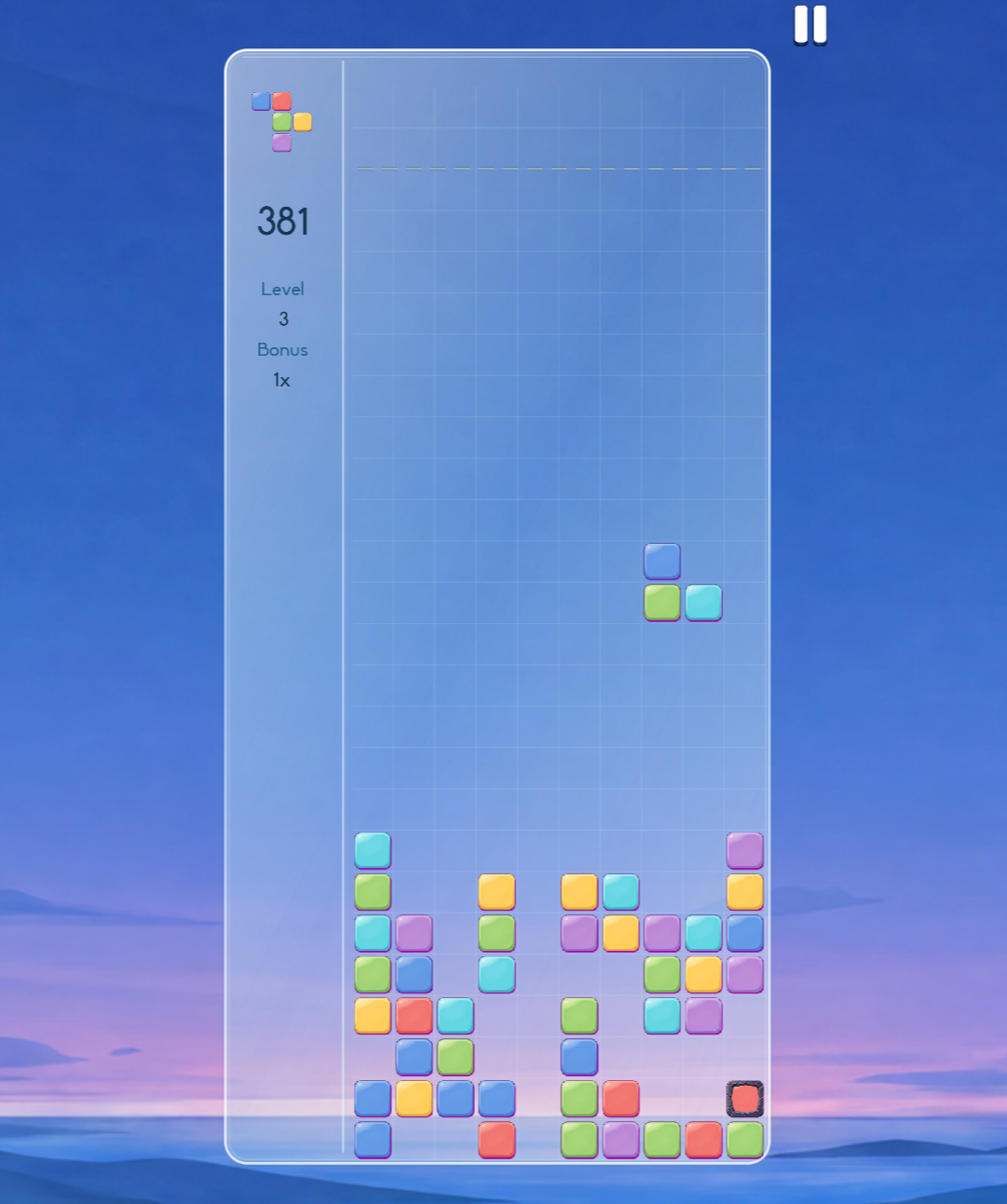
Two rules, one decision
Most turns present two useful questions: where does the shape fit, and where do its colors belong? A narrow gap may help complete a row. The same piece may also extend a diagonal color match somewhere else.
After the piece locks, both kinds of clear are found together. That makes Tetcolor Duo less about following one familiar pattern and more about balancing several possible outcomes.
Pieces and styles
Duo draws shapes from both Tetcolor and Retris traditions. Every occupied block chooses one of six colors independently, even when the silhouette comes from a four-block row-clearing shape. Rotation preserves the colors inside the shape.
Normal becomes faster as the level rises. Relax holds one selected speed. Crazy adds five especially awkward shapes, including the 2 × 4 box, Capped Bar, Fork, H and C. Arcade and Classic both support all three styles on the same 10 × 24 field.
What disappears
A pass qualifies:
- every run of at least three same-colored blocks horizontally, vertically or on either diagonal; and
- every fully occupied horizontal row, whatever its colors.
The game combines both results into one removal. If a block belongs to a color match and a full row, it disappears and scores once—not once for each rule.
Cascades join the rules
After a clear, surviving blocks fall vertically inside their columns. The settled board is checked again using both rules. A color match can open space that completes a row after collapse; a row clear can bring matching colors together.
The score for each pass uses the number of unique removed blocks. The multiplier begins at ×1 and doubles with every successful cascade until the next falling piece takes control.
In Arcade, each colored block on a new piece can carry one primary Arcade Special: Normal Bomb, Horizontal Bomb, Vertical Bomb, Lightning Bomb, Mega Bomb, Bomb Activator, or Stone Cover. It can also carry an Ice Cover over the block or special. A color match and a full row qualify together; an overlap strikes a block once. Ordinary scoring counts only blocks actually destroyed, so protected ice and an ordinary-hit Stone Cover do not score.
Normal Bomb reaches eight neighbors, Horizontal Bomb its occupied row, Vertical Bomb its occupied column, Lightning Bomb every block of its color, and Mega Bomb combines all four areas. Bomb generations resolve serially at 0.5-second intervals; each unique block destroyed only by a bomb adds 1 point. Bomb Activator disappears and triggers all settled bombs without a local blast, with simultaneous activators deduplicated into one global trigger. Stone Cover survives ordinary removal, remains at its settled coordinate as support and a column barrier, and can be destroyed only by a bomb.
The first strike on Ice Cover removes only the ice and does not activate the covered special; a later bomb generation can reach the exposed block. Freshly thawed blocks stay anchored for that resolution. Collapse waits for every wave and then moves blocks vertically within segments divided by surviving Stone Covers and thaw anchors. Across settled, current, and preview blocks, the capacities are five bombs including Mega Bombs, three Bomb Activators, ten Stone Covers, and ten Ice Covers.
Useful Duo habits
- Keep partial color matches near unfinished rows. One placement can then advance both plans.
- Watch diagonals before filling an obvious hole; a color in the wrong corner can break a larger setup.
- Leave vertical space beneath useful fragments. Collapse is what turns a simple clear into a chain reaction.
- In Arcade, place bombs where either Duo rule can reach them; a near-full row beside a color setup gives you two ways to begin the chain.
- In Crazy, inspect the whole silhouette before dropping. Large pieces can solve several gaps, but they also close escape routes quickly.
Common questions
Do full rows need matching colors?
No. Occupancy clears the row; color only matters to the four-direction matching rule.
Can one block count twice?
No. Overlapping results are merged before removal and scoring.
Does Crazy change the clearing rules?
No. Crazy changes the available shapes. Color matches and complete rows still resolve together.
What does Arcade add?
It keeps Duo's combined rules and Classic-sized field, while new pieces can carry layered Arcade Specials that resolve before segmented gravity resumes.
Use both rules
Return to the playable homepage and choose Tetcolor Duo from the first menu tile.